Home › Free › The 70/20/10 budget rule in Australia (with fortnightly examples)
The 70/20/10 budget rule in Australia (with fortnightly examples)

The 70/20/10 budget is one of the simplest ways to split your pay: 70% for living costs, 20% for savings and 10% for debt repayments or giving. It's a rule of thumb, not a law, and it suits people who want a quick plan without tracking every dollar. This guide shows how it works with Australian fortnightly pay, how it compares with the better-known 50/30/20 rule, and when to tweak it.
How the 70/20/10 rule works
- 70% living: rent or mortgage, groceries, power, phone, transport, insurance, and your fun money too. Unlike 50/30/20, needs and wants share one bucket.
- 20% savings: an emergency fund, a house deposit, holidays, Christmas, or sinking funds for annual bills.
- 10% debt or giving: extra repayments on credit cards or personal loans, or giving if you're debt-free. Some people use it as a second savings goal.
Use your take-home pay, the amount that actually lands in your account after tax. If you salary-sacrifice to super, that's already taken out before your pay arrives.
A fortnightly example (made-up numbers)
These figures are made up to show the maths. They aren't typical wages or costs.
| Bucket | Share | Take-home $2,400 per fortnight | Take-home $1,800 per fortnight |
|---|---|---|---|
| Living | 70% | $1,680 | $1,260 |
| Savings | 20% | $480 | $360 |
| Debt or giving | 10% | $240 | $180 |
In the $2,400 example, the living bucket of $1,680 has to cover the fortnight's share of rent, bills, groceries and fun. Say rent is a made-up $900 a fortnight, groceries $300, transport $120 and bills $200 (converted to per fortnight). That's $1,520, leaving $160 of fun money inside the 70%.
Converting bills to fortnightly
Most budgeting trouble comes from bills that don't match your pay cycle. To convert:
- Weekly to fortnightly: × 2
- Monthly to fortnightly: × 12 ÷ 26
- Quarterly to fortnightly: × 4 ÷ 26
- Yearly to fortnightly: ÷ 26
Put the per-fortnight amount for annual bills like car rego or insurance aside each pay, so the bill doesn't land on a single fortnight. That money comes out of the 70%, because it's a living cost, not savings.

70/20/10 vs 50/30/20
| 70/20/10 | 50/30/20 | |
|---|---|---|
| Split | 70% living, 20% savings, 10% debt or giving | 50% needs, 30% wants, 20% savings and debt |
| Needs vs wants | Combined in one bucket | Kept separate |
| Debt | Its own 10% | Shares the 20% with savings |
| Made-up $2,400 fortnight | $1,680 / $480 / $240 | $1,200 / $720 / $480 |
| Suits | High-rent areas, people who don't want to sort needs from wants | People whose essentials fit in half their pay |
The big difference is how much room you get for essentials. If rent takes a big share of your pay, fitting every need into 50% can be hard, and 70/20/10 gives more room. On the other hand, 50/30/20 puts a firm cap on wants, which some people find easier to stick to. Neither is "right". Pick the one you'll actually stick to.
When to tweak the percentages
- Living costs over 70%: try 80/10/10 for now and review when your rent or income changes.
- High-interest debt: you might swap to 70/10/20 so more goes to debt while you clear it.
- No debt: roll the 10% into savings or a goal like a holiday or Christmas.
- Irregular income: base the split on a lower typical fortnight and save anything extra.
 Money HQYour whole money life in one browser app: payday-aware budget, bills calendar, savings goals, debt payoff and net worth.See the app →
 Fortnightly Budget DashboardPlan every payday: bills smoothed across fortnights, a tick-off payday planner, three-pay months and savings goals.See the app →
Setting it up in ten minutes
- Find your take-home pay per fortnight.
- Work out the 70%, 20% and 10% amounts.
- List your living costs per fortnight and check they fit inside the 70%.
- Set up automatic transfers on payday for the 20% and 10%, so savings happen first.
- Review after a couple of pays and adjust.
Plan it in the Fortnightly Budget app
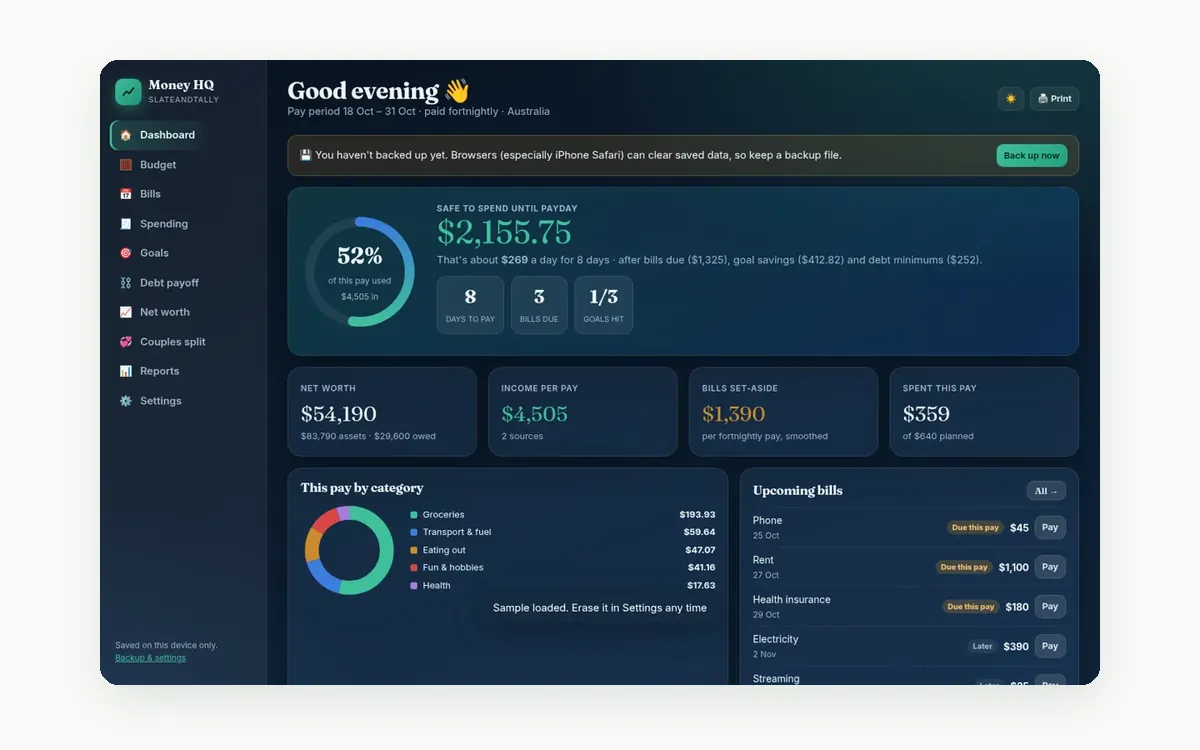
Our Fortnightly Budget app converts bills at any frequency to a per-pay amount, lists the bills each pay has to cover, tracks savings goals and shows what's safe to spend until next payday, which makes it easy to check your living costs fit inside the 70%.
Bills at any frequency converted to a per-pay amount, a payday planner with tick-off, goals and per-pay savings, and a year view that spots the three-pay months. It works offline in your browser, your data stays on your device, and there is no bank login. Secure checkout via Payhip.
See the Fortnightly Budget app · A$29
Saving for lots of goals at once? Sinking Funds (A$19) keeps a jar for each.
Frequently asked questions
What is the 70/20/10 budget rule?
It splits your take-home pay into 70% for living costs, 20% for savings and 10% for debt repayments or giving.
Is 70/20/10 better than 50/30/20?
Neither is better for everyone. 70/20/10 gives more room for living costs and keeps debt separate. 50/30/20 separates needs from wants. Choose the one you can stick to.
Does 70/20/10 use gross or take-home pay?
Use take-home pay, the amount that lands in your account after tax.
How do I use 70/20/10 if I'm paid fortnightly?
Work out 70%, 20% and 10% of each fortnightly pay, and convert monthly or yearly bills to per-fortnight amounts so they fit the 70%.
What if my rent alone is more than 70%?
Adjust the split, for example to 80/10/10, for now. For free help, see moneysmart.gov.au or call the National Debt Helpline on 1800 007 007.
Does the app need an account or bank login?
No. It works offline in your browser and your data stays on your device.
General information only, not financial advice. Examples use made-up numbers. For free, independent help, see moneysmart.gov.au or a free financial counsellor.