Home › Free › Airbnb income tax in Australia: what to declare and what to keep
Airbnb income tax in Australia: what to declare and what to keep
Renting out a spare room, a granny flat or your whole place on Airbnb, Stayz or another platform? In Australia that money is generally income you need to declare. This guide explains, in plain English, what the ATO says counts as income, which expenses you may be able to claim, how claims are split when it's also your home, and the records worth keeping all year. It's general information only, not tax advice. For your situation, check the ATO pages linked below or speak with a registered tax agent.
What counts as income
The ATO says you need to include all income earned from renting your property through a digital platform. That includes:
- all income before fees and commissions are taken out, including any host or cleaning fees
- insurance payouts, for example compensation for damage caused by guests
- bonds or security deposits you become entitled to keep
- letting and booking fees you charge, including cancellation fees.
The ATO also says it receives data from digital platforms operating in Australia, so it's worth making sure the figures you declare match your platform statements. The myTax 2026 instructions for rent cover where rental income goes in your return.
A made-up example: guests paid $9,000 across the year, and the platform kept $1,350 in fees. The income to start from is the $9,000, not the $7,650 that landed in your account. The platform fees are then a cost you may be able to claim.
Expenses you may be able to claim
According to the ATO, common expenses you may be able to claim all or part of include:
- council rates
- interest on a loan for the property
- electricity, gas and water
- property insurance
- cleaning and maintenance costs
- fees or commission charged by the platform.
The ATO says you can claim 100% of expenses that only relate to renting to paying guests, such as platform fees. Shared household costs have to be split.
Splitting costs when it's also your home
If you live in the property, only part of each shared cost relates to the rental. The ATO describes two ways to work out that part, and if you rent out a room in your home you may need to use both:
- Time-based: the number of days the space was rented out during the year.
- Area-based: the floor area the guest uses, such as a room plus a share of common areas like the kitchen and living room.
The ATO's renting out part of a home page gives the formulas. Here's a simplified, made-up example of how both methods combine. The room plus its share of common areas works out to 25% of the home, and it was rented for 120 of 365 days. So for a $2,400 electricity bill, the rental share would be roughly $2,400 × 25% × 120 ÷ 365, which is about $197. Your own figures and method may differ, so check the ATO page or ask a registered tax agent.

GST and capital gains tax
- GST: the ATO's myTax rent instructions say GST isn't payable on amounts of residential rent you earn. Check the ATO for your arrangement if you're unsure whether what you offer counts as residential rent.
- Capital gains tax: the ATO explains that if you rent out part of your home, the capital gain or loss for that portion during the rental period would be assessable. In other words, you may not get the full main residence exemption when you sell. Keep records from day one.
Records worth keeping all year
Good records make tax time much easier, and they're what any apportionment is built on:
- Platform statements: download the yearly earnings summary and keep the monthly payouts.
- A booking log: dates booked, nights, the gross amount and the fees for each stay.
- Days available and days used privately: note when the space was blocked out for family or your own use.
- Floor areas: measure the rented space and common areas once and keep the figures.
- Receipts and bills: utilities, insurance, rates, cleaning, linen, toiletries and repairs.
- Before-and-after notes: photos and invoices for any damage and insurance claims.
Many hosts set aside part of each payout during the year, so tax time doesn't bring a surprise. Our tax set-aside calculator can help you pick a percentage to put away. It's a planning estimate, not a tax calculation.
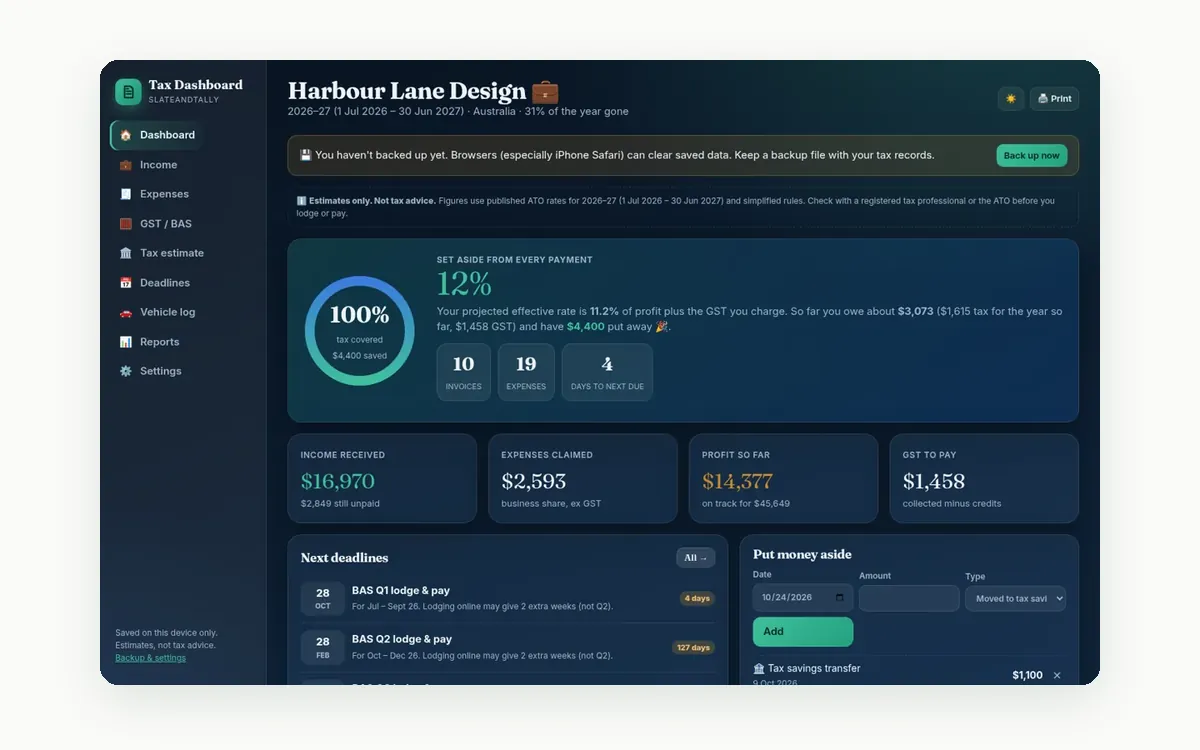
 Sole Trader Tax & BASTrack income, expenses and GST, see BAS figures by quarter, and estimate how much tax to set aside.See the app →
 Money HQYour whole money life in one browser app: payday-aware budget, bills calendar, savings goals, debt payoff and net worth.See the app →
Hosting as a side hustle
If hosting sits alongside a job or other gigs, keeping each income stream separate makes things clearer. Our guide to side hustle tax in Australia covers the bigger picture, and our side hustle income records guide shows a simple way to log money in and out.
Income by stream (hosting, gigs, sales), expenses with a receipt tick, your own tax set-aside percentage and a running total of what to put away. It works offline in your browser, your data stays on your device, and there is no bank login. Secure checkout via Payhip.
See the Side Hustle Tax app · A$29
Where to get help
The ATO pages linked above are the official source. For advice about your own situation, including whether hosting is a business and how CGT applies when you sell, speak with a registered tax agent.
Frequently asked questions
Do I pay tax on Airbnb income in Australia?
Generally, yes. The ATO says you need to include all income from renting your property through a digital platform in your tax return, before fees and commissions. See the ATO page.
Do I declare the amount before or after Airbnb fees?
The ATO says to include income before fees and commissions are deducted. Platform fees are then an expense you may be able to claim.
Can I claim expenses if I live in the home?
You may be able to claim part of shared costs, apportioned by the days rented and the floor area used. The ATO explains both methods on its renting out part of a home page.
Is GST charged on Airbnb rent?
The ATO's myTax rent instructions say GST isn't payable on residential rent. Check with the ATO if you're unsure how this applies to you.
Does hosting affect capital gains tax?
It can. The ATO explains that renting out part of your home may mean part of any capital gain is taxable when you sell. Speak with a registered tax agent.
General information only, not tax or financial advice. Facts are summarised from ATO pages (linked above), checked 27 October 2026, and can change. Examples use made-up numbers. Check ato.gov.au or speak with a registered tax agent about your situation.