Home › Free › Free chore chart printable for kids (A4 PDF)
Free chore chart printable for kids (A4 PDF)
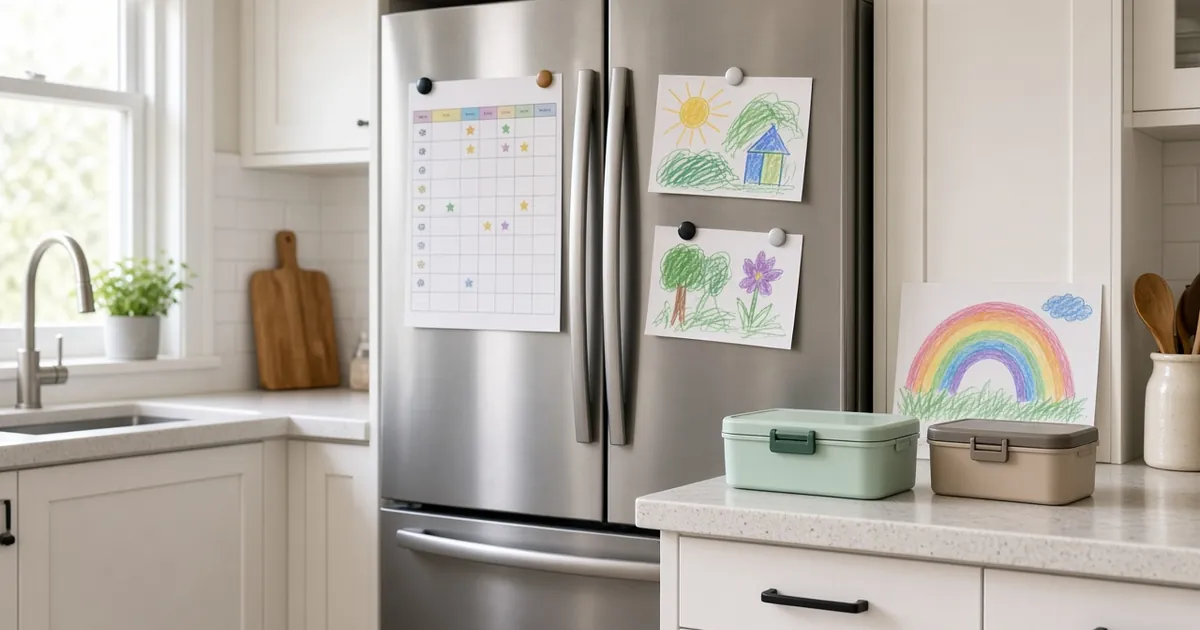
A chore chart on the fridge is one of the oldest family tricks, and it still works. Kids can see what is expected, tick things off themselves, and connect a little effort with a little pocket money. Below you can download our free A4 weekly chore chart for kids, which you can fill in on screen or print. There is no sign-up. Then read on for age-by-age chore ideas and ways to link chores to pocket money.
Download the free chore chart (A4 PDF)
No email or sign-up needed.
What's on the chore chart
- Name and week starting, so you can keep a stack of past weeks.
- Twelve chore rows with a tick box for each day, Monday to Sunday.
- A "worth" column, if you pay per tick.
- End of week tally: base pocket money, chore money and total.
- Spend / Save / Give split, plus a line for what they are saving up for.
Age-appropriate chore ideas
Every child is different, so use these as a starting point and adjust to what your kids can manage.
Ages 3 to 5
- Put toys back in the box
- Put dirty clothes in the basket
- Help feed the pet
- Carry their plate to the bench
- Match socks
Ages 6 to 8
- Make their bed
- Set and clear the table
- Pack their own school bag
- Water the garden
- Help unpack the groceries
Ages 9 to 12
- Empty the dishwasher
- Put out the bins on bin night
- Vacuum their room
- Fold and put away washing
- Help cook a simple dinner
Teens
- Cook a family meal each week
- Mow the lawn
- Clean the bathroom
- Do their own washing
- Help with the weekly grocery list
Should chores be linked to pocket money?
Families do this differently, and there is no single right way. Three common approaches:
- Base plus bonus: a small base amount each week, plus extra for chores done. This is the approach the chart is built for.
- Per chore: each chore has a set value, and pay is the total of ticks.
- Separate: some chores are just part of being in the family and are never paid, while pocket money is a fixed allowance to learn money skills with.
Whichever you choose, keep the rule simple and consistent, and agree it with your kids up front. Our pocket money chart guide for Australia goes deeper on amounts and approaches.
Spend, Save and Give jars
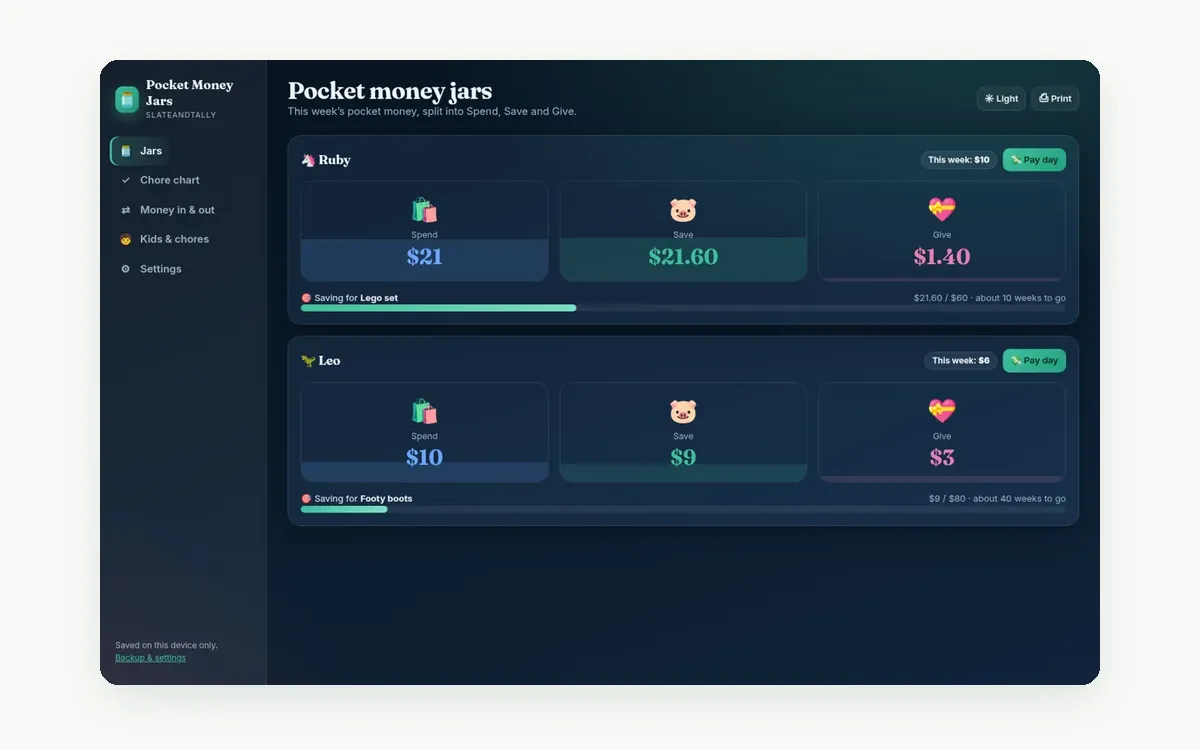
Splitting pocket money into three jars is a simple way to teach that money can do different jobs. Spend is for now. Save is for a goal they choose, like a toy, a game or a day out. Give is for a cause or a gift for someone else. Letting kids choose their own savings goal makes saving feel real, and seeing the Save jar grow week by week teaches patience better than any lecture.

Tips for making a chore chart stick
- Start small. Three or four chores is plenty at first. Add more once the habit is there.
- Let them tick it. Kids love marking off their own progress.
- Pay on the same day. A regular "pay day" each week builds trust.
- Model it. Kids notice when grown-ups do their chores too.
- Review each term. As kids grow, swap in more grown-up jobs and adjust the amounts.
- Print a stack. Keep a few blank charts in a drawer so a new week is always ready.
Setting it up in ten minutes
Sit down with your kids and agree on the chores together. Write three to five in the chore rows, using simple words or even little drawings for younger children. Decide whether each one is daily or only on certain days, and shade out the days a chore does not apply. If you pay per tick, write the amount in the "worth" column. Then pick a pay day, such as Sunday night, when you add up the ticks together and fill in the end-of-week box. Asking kids to work out the total themselves is a sneaky bit of maths practice.
Finally, agree how the total splits between Spend, Save and Give. Some families use equal thirds, others put most into Spend for younger kids and shift towards Save as they get older. Write the goal they are saving for at the bottom so it is visible all week.
 Pocket Money JarsChores, weekly ticks and Spend / Save / Give jars to help kids learn about money.See the app →
 Money HQYour whole money life in one browser app: payday-aware budget, bills calendar, savings goals, debt payoff and net worth.See the app →
Several kids? Use one chart each
A chart for each child avoids arguments about whose tick is whose, and lets you set different chores and amounts by age. Print one per child, or fill them in on screen and print the week.
When you want the chart and the jars in one place
Paper charts are great on the fridge. Keeping track of balances across weeks, birthday money and purchases is where it gets messy. Our Pocket Money Jars app keeps it all together: tap a star each day a chore is done, and one tap on pay day pays the week's base plus chores into each child's jars. It tracks pretend jars, so keep the real cash or bank account in step.
A chore chart where you tap a star each day a chore is done, Spend / Save / Give jars for each child with a savings goal, one-tap pay day, and money in and out for birthday money, purchases and donations. It works offline in your browser, your data stays on your device, and there is no bank login. Secure checkout via Payhip.
See the Pocket Money Jars app · A$19
Looking for more? There are more free printables here, and the Back to School Planner (A$19) helps plan each child's school list and costs.
Frequently asked questions
Is the chore chart printable free?
Yes. Download the A4 PDF above. There is no email or sign-up.
Can I fill it in on screen?
Yes. The PDF has fillable text fields and tick boxes. You can also print it and use a pen or stickers.
How much pocket money should I pay for chores?
It is up to each family. Many start with a small base amount and add a little for each chore, adjusting by age.
What chores suit a 5-year-old?
Simple jobs like packing away toys, putting clothes in the basket, helping feed a pet and carrying their plate to the bench.
Does the Pocket Money Jars app hold real money?
No. It tracks pretend jars, so keep any real cash or bank account in step with it.
General information only, not financial or parenting advice. Choose chores that are safe and suitable for your child's age and abilities, and supervise as needed.