Home › Free › Free debt tracker printable (A4, fillable PDF)
Free debt tracker printable (A4, fillable PDF)

When you owe money on more than one card or loan, the hardest part is often just seeing it all in one place. A printable debt tracker gives you that view on a single page: every balance, rate and minimum repayment, the order you will tackle them, and a log of each payment. Below you can download our free A4 debt tracker. It is fillable on screen or printable for the fridge, with no sign-up. Then read on for how to use it.
Download the free debt tracker (A4 PDF)
No email or sign-up needed.
What's on the printable
- My debts: eight rows for each card, loan or buy now, pay later balance, with balance, interest rate, minimum repayment, due day and your payoff order.
- My plan: tick avalanche or snowball, and write the extra amount you can pay each pay and your total debt today.
- Payment log: ten rows to record the date, debt, amount paid and new balance.
- Progress boxes: fifty boxes to colour in, one for every A$100 paid off. It is a small thing, but seeing them fill up keeps you going.
How to use a debt tracker
- Gather your statements. Log into each account or check your latest statement for the balance, interest rate and minimum repayment. Do not guess, as the rate makes a big difference.
- List every debt. Include credit cards, personal loans, car loans, store cards and BNPL. Many people keep their home loan and HELP debt separate, because those work differently.
- Write down your total. It can be confronting, but it is the starting line.
- Choose an order. Pick avalanche or snowball (explained below) and number your debts.
- Find your extra amount. Pay the minimums on everything, then put any extra toward debt number one.
- Log every payment. Write each payment and the new balance. When debt number one is paid, roll its repayment into number two.
Avalanche or snowball?
The two most common payoff methods differ only in the order:
- Avalanche: pay off the debt with the highest interest rate first. This usually costs the least interest overall.
- Snowball: pay off the smallest balance first. You clear a debt sooner, and that early win can keep you motivated.
Neither is wrong. The best method is the one you will stick with. If you would like to see the difference in numbers, try our free debt snowball calculator or read debt snowball vs avalanche in Australia.
Tips that make a debt tracker work
- Update it on payday. Tie it to a routine so it does not get forgotten.
- Put it where you will see it. The fridge, a noticeboard, or pinned on your desktop.
- Stop adding to the pile. If you can, pause using the cards you are paying down.
- Celebrate each payoff. A small, cheap reward when a debt hits zero keeps momentum.
- Watch the due days. Late fees and missed payments set you back. The due day column is there for a reason.

If debt feels overwhelming
A tracker helps you organise debt, but it cannot fix a situation where repayments are more than you can manage. In Australia, free and confidential help is available from the National Debt Helpline on 1800 007 007 (ndh.org.au), run by not-for-profit financial counsellors. Contacting your lender early about hardship options can also help. You do not need to pay anyone to talk to a financial counsellor.
A worked example (made-up numbers)
Say you have three debts: a store card with a $600 balance, a credit card with $2,400, and a car loan with $9,000. You write all three in the "My debts" table with their rates and minimums. If you choose snowball, the store card is number one because it is the smallest. If you choose avalanche, whichever has the highest interest rate goes first, which is often the credit card. Either way, you keep paying the minimum on every debt, and any extra goes to number one.
Suppose you can find an extra $50 each pay by trimming takeaway. That $50 goes to debt number one on top of its minimum. Once it is cleared, its minimum plus the $50 rolls onto debt number two, so the amount you throw at each debt grows as you go. That rolling effect is why both methods speed up towards the end. These numbers are only an illustration. Use your own statements for the real figures.
 Debt Payoff PlannerSee your debt-free date, compare avalanche vs snowball, and log every payment.See the app →
 Money HQYour whole money life in one browser app: payday-aware budget, bills calendar, savings goals, debt payoff and net worth.See the app →
Paper or on-screen?
The PDF works both ways. Print it in black and white on plain A4 paper, or open it in a free PDF reader and type straight into the fields. Some people do both: type the debt list once, then print a copy each month for the fridge and colour in the progress boxes by hand. If you prefer a fresh start each quarter, save a new copy and keep the old one as a record of how far you have come.
When paper is not enough
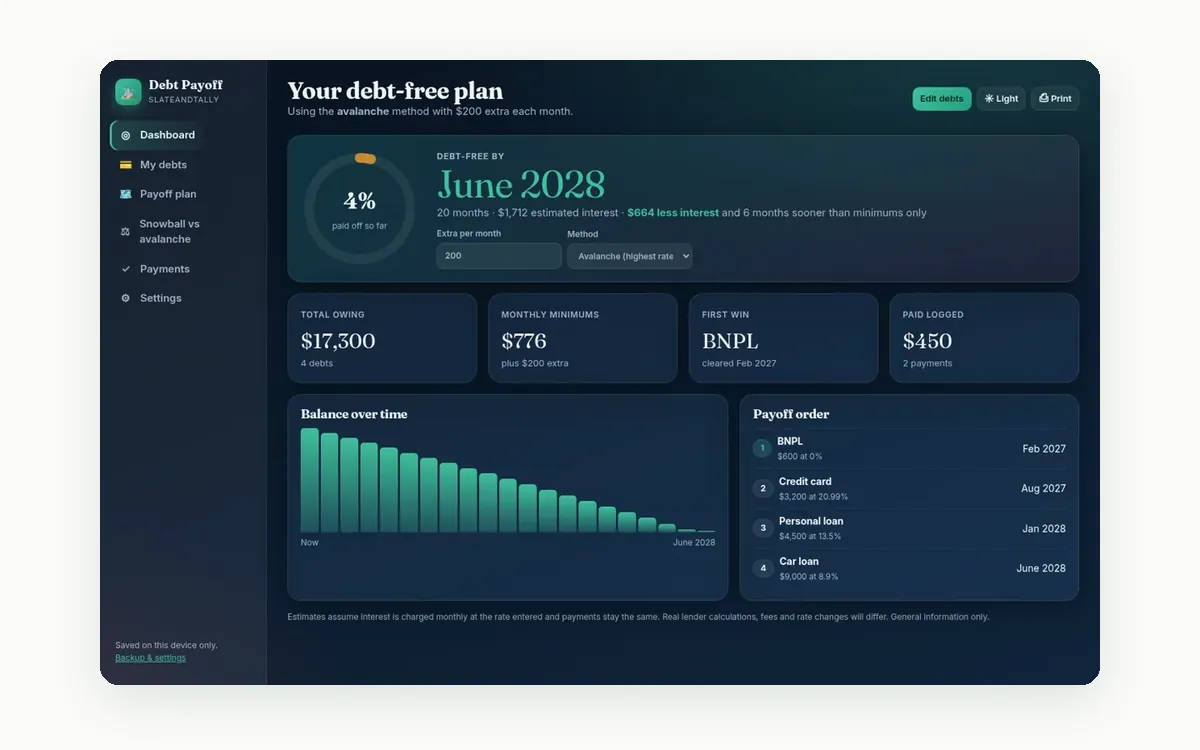
A printable is a great start. As balances fall and you add payments, though, the maths gets fiddly: interest changes each month, and it is hard to see your debt-free date on paper. That is where our Debt Payoff app helps. It works out your month-by-month payoff order, compares avalanche and snowball, and lets you try what-if extra amounts.
See your debt-free date, compare avalanche vs snowball, try what-if extra amounts, and log every payment as balances fall. Interest figures are simplified estimates. Your lender’s statements are the source of truth. It works offline in your browser, your data stays on your device, and there is no bank login. Secure checkout via Payhip.
See the Debt Payoff Planner app · A$25
Want debt payoff alongside your budget, bills and net worth? It is built into Money HQ (A$59). Our debt payoff planner guide has more on getting started, and there are more free printables here.
Frequently asked questions
Is the debt tracker printable really free?
Yes. Download the A4 PDF above. There is no email or sign-up.
Can I fill it in on my computer?
Yes. The PDF has fillable fields and tick boxes, so you can type into it in most PDF readers, or print it and write by hand.
Should I use avalanche or snowball?
Avalanche (highest rate first) usually costs less interest. Snowball (smallest balance first) gives quicker wins. Pick the one you will stick with.
Should I include my home loan or HELP debt?
Many people track those separately, because they work differently from cards and personal loans. The tracker works either way.
Where can I get free help with debt in Australia?
The National Debt Helpline (1800 007 007, ndh.org.au) offers free, confidential financial counselling.
General information only, not financial advice. The printable and app are organising tools and interest figures are estimates. For help with your situation, contact the National Debt Helpline on 1800 007 007 or a licensed financial adviser.