Home › Free › Student budget in Australia: a simple fortnightly plan
Student budget in Australia: a simple fortnightly plan

Being a student in Australia often means juggling rent, groceries, transport, textbooks and a part-time job, all on a tight and sometimes irregular income. A student budget does not need to be complicated. It just needs to show what comes in, what has to go out, and what is left for everything else. This guide walks you through building a simple student budget that fits how students actually get paid, with a template you can copy and some practical ways to make your money stretch further.
Step 1: list your income per fortnight
Student income often comes from several places at different times: casual or part-time wages, government payments, family help, scholarships or a side hustle. Put everything on the same footing by converting it to a fortnightly amount. Weekly income × 2. Monthly income × 12 ÷ 26. One-off amounts (like a scholarship paid per semester) ÷ the number of fortnights they need to last.
If your hours change from week to week, use a conservative figure, such as your lowest typical fortnight, and treat anything extra as a bonus for savings. If you receive or are thinking about government student payments, the official information and eligibility rules are on the Services Australia website.
Step 2: cover the essentials first
Rent, utilities, phone and internet come first, because missing them causes the most trouble. If you share a house, agree in writing how bills are split. Convert each bill to a per-fortnight amount so you know exactly what each pay has to cover.
Step 3: plan for semester costs
Student life has its own lumpy costs that can wreck a fortnight if they arrive unplanned: textbooks, a new laptop, course materials, field trips, graduation, and trips home in the holidays. Make a list at the start of each semester, estimate each one, and divide the total by the number of fortnights until you need it. Even $10 or $20 a fortnight adds up.
Step 4: food and transport
These are usually the biggest flexible costs. A few things that help:
- Meal plan around specials. Plan a week of meals before you shop, and cook in batches.
- Check student concessions. Many public transport networks offer student concession fares. Check your state transport agency's website for the rules.
- Ask about student discounts. Software, phone plans and some shops offer them, but only count a discount if you would have bought the thing anyway.
- Bring lunch and a water bottle. Small daily savings add up across a semester.
Step 5: what is left is your fun money
Once essentials, semester costs, food and transport are covered, the rest is yours: going out, hobbies, clothes, subscriptions. Giving yourself a fixed amount for fun each fortnight makes it much easier to enjoy it without guilt and still make rent.

A student budget template
| Section | Per fortnight |
|---|---|
| Income (wages, payments, help, side hustle) | $ |
| Rent | $ |
| Bills (power, phone, internet) | $ |
| Semester set-aside (textbooks, laptop, trips home) | $ |
| Groceries | $ |
| Transport | $ |
| Savings or emergency buffer | $ |
| Fun money (what is left) | $ |
Copy it into a notebook, notes app or spreadsheet, or use our free printables, no sign-up needed.
A worked example (made-up numbers)
Say a student brings in $1,000 a fortnight from casual work and other income. Rent in a share house is $480, bills $60, a semester set-aside $40, groceries $160, transport $50 and savings $50. That leaves $160 as fun money for the fortnight. These figures are invented for illustration only, so use your own.
Build a small emergency buffer
A cracked phone screen or a surprise bill can derail a tight budget. Aim to build a small buffer, even a few hundred dollars over time, kept separate from your everyday account. Your university's student services may also offer financial counselling or support, and the government's Moneysmart website has free, independent guides.
 Money HQYour whole money life in one browser app: payday-aware budget, bills calendar, savings goals, debt payoff and net worth.See the app →
 Fortnightly Budget DashboardPlan every payday: bills smoothed across fortnights, a tick-off payday planner, three-pay months and savings goals.See the app →
Moving out of home for study
If you are moving out for the first time, budget for the start-up costs as well as the ongoing ones: a rental bond, the first rent payment, basic furniture and kitchen gear, and connection costs. Make a list, price each item, and start setting money aside a few months before you move. Second-hand furniture and shared household items can make a big difference.
Tips that make a student budget stick
- Do it on payday. Ten minutes each pay beats a big spreadsheet once a semester.
- Watch buy now, pay later and subscriptions. Small repayments and auto-renewals add up quietly. Moneysmart has guides on both.
- Plan the holidays. Work hours, and therefore income, often change between semesters.
- Keep it simple. A budget you use is better than a perfect one you abandon.
Plan every pay, even when hours change
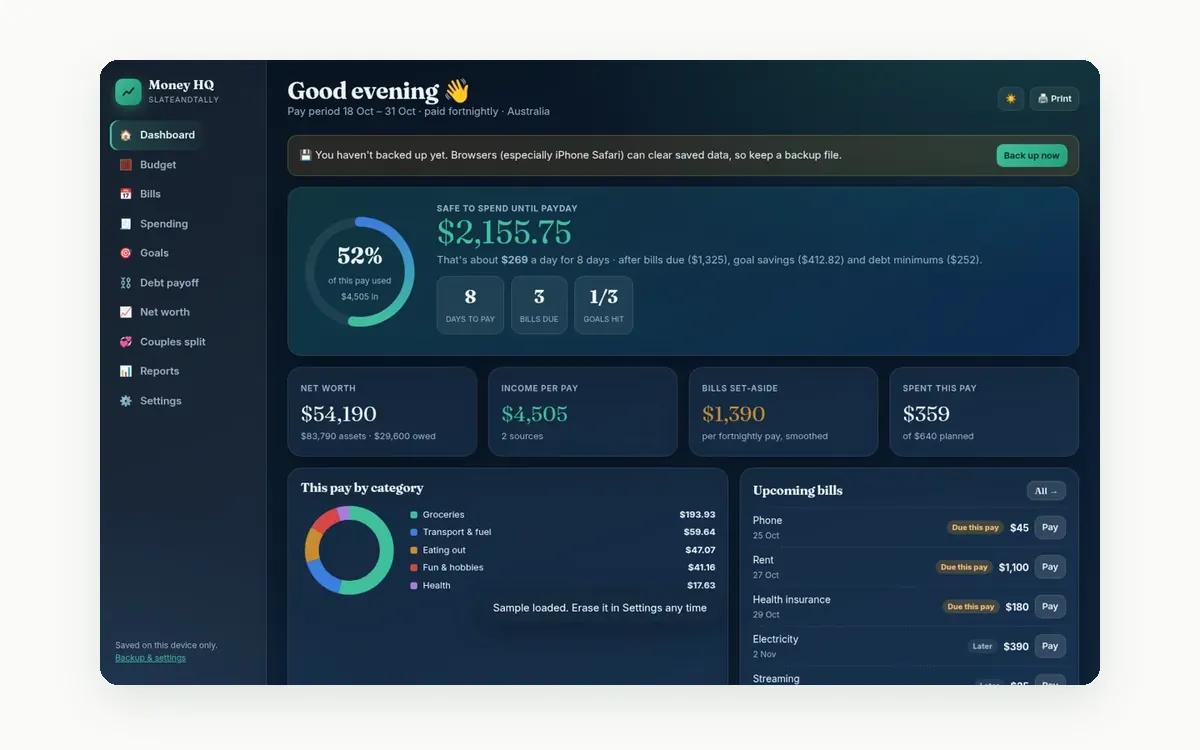
Our Fortnightly Budget app converts every bill to a per-pay amount, lists the bills each pay has to cover, tracks savings goals and shows a "safe to spend until next payday" number.
Bills at any frequency converted to a per-pay amount, a payday planner with tick-off, goals and per-pay savings, and a year view that spots the three-pay months. It works offline in your browser, your data stays on your device, and there is no bank login. Secure checkout via Payhip.
See the Fortnightly Budget app · A$29
Saving for textbooks or a trip home? Sinking Funds (A$19) keeps a jar for each. Cooking on a budget? Try Meal & Grocery (A$19).
Frequently asked questions
How do I make a student budget in Australia?
List all income per fortnight, cover rent and bills first, set aside small amounts for semester costs, plan groceries and transport, and treat the rest as fun money.
How do I budget with irregular casual hours?
Use your lowest typical fortnight as your income figure and put anything extra towards savings or semester costs.
Where can I find official info on student payments?
Eligibility and payment rules are on the Services Australia website.
Is there a free student budget template?
Yes. The template on this page is free to copy, and our free printables need no sign-up.
Does the app need an account or bank login?
No. It works offline in your browser and your data stays on your device.
General information only, not financial advice. Examples use made-up numbers. For free, independent help, see moneysmart.gov.au, your university's student services, or a free financial counsellor.