Home › Free › ABN tax return for sole traders: how it works in Australia
ABN tax return for sole traders: how it works in Australia

If you have an ABN and work for yourself as a sole trader, tax time looks a little different from when you only had a payslip. The good news: there is no separate "business tax return" for a sole trader. You report your business income in your own individual return, with some extra sections. This guide walks through how that works in plain English, using the ATO's own pages as the source for every rule. We are not tax agents and this is not tax advice. It is a map so you know what to expect and where to check.
Do I lodge a separate return for my ABN?
No. The ATO explains that if you are a sole trader you use your individual tax return to report business income. You do not lodge a separate business return. The ATO says you must declare the income you earn from your business in your individual tax return, and that the net income from carrying on a business is assessable income, so it sits in the same return as any wages (ATO, Business, partnership and trust income).
That matters if you run an ABN side hustle while working a job. The wages from your employer and the profit from your side business land in the same return, and tax is worked out on the combined amount. Plenty of people are surprised at tax time because the job withheld tax from their pay but nothing was withheld from their side income. That is the gap we built our trackers to help you see coming.
Do I have to lodge if I earned under $18,200?
Yes, if you are a sole trader. The ATO's sole trader page says you must lodge a tax return even if your income is below the tax-free threshold (ATO). The tax-free threshold for Australian residents is $18,200 (ATO, Tax rates for Australian residents). Being under the threshold may mean little or no tax is payable, but it does not mean you can skip the return.
What goes into a sole trader tax return
According to the ATO, a sole trader's return is the individual return plus the supplementary section and the business and professional items schedule. In practice, that means you will report:
- Your ABN and your main business activity.
- Your business income: sales, fees and other amounts the business earned.
- Your business expenses, so the return shows a net profit or loss.
- Any wages, interest or other income you also had, as usual.
- Any PAYG instalments you paid during the year. These are credited against the tax you owe.
The ATO then works out your tax on the total. If you paid PAYG instalments, those amounts are credited, so the final bill or refund reflects what you have already paid (ATO).
Doing it yourself in myTax
If you lodge your own return online through myTax (via myGov), the ATO's instructions say to use the Personalise return step and select the option that you were a sole trader or had business income. That opens the business income or loss section, where you enter your ABN, your main business activity and your figures (ATO myTax instructions, Net income or loss from business). Have your records ready before you start: totals of income and expenses for the financial year, which runs from 1 July to 30 June.
A tidy year-long log makes this step far quicker. If every invoice and receipt is already sorted into categories, you are copying totals into myTax rather than digging through emails and bank statements.

When is the sole trader tax return due?
For people who lodge their own return, the ATO says the due date is 31 October. When a due date falls on a weekend or public holiday, you can lodge on the next business day. In 2026, 31 October is a Saturday, and the ATO says people lodging their own return have until 11:59 pm local time on Monday 2 November 2026 (ATO, Preparing your tax return; ATO media release).
If you use a registered tax agent, you usually get a later due date, provided you are on the agent's books before 31 October (ATO, Lodge with a registered tax agent). If your return is lodged between 1 July and 31 October and you have tax to pay, the ATO says payment is generally due on 21 November (ATO).
Running late? We have a plain-English page on what to do about a late tax return and a 31 October self-lodge checklist.
Tax rates that apply to your combined income
Your business profit is taxed at the same individual rates as wages. For 2025–26, the ATO lists these resident rates (ATO, Tax rates for Australian residents):
| Taxable income | Tax on this income |
|---|---|
| 0 – $18,200 | Nil |
| $18,201 – $45,000 | 16c for each $1 over $18,200 |
| $45,001 – $135,000 | $4,288 plus 30c for each $1 over $45,000 |
| $135,001 – $190,000 | $31,288 plus 37c for each $1 over $135,000 |
| $190,001 and over | $51,638 plus 45c for each $1 over $190,000 |
These rates do not include the Medicare levy of 2%. The ATO also notes the rate for the first bracket changes to 15% from 2026–27. Always check the current table on ato.gov.au, as rates can change.
PAYG instalments: paying as you go
Once you have business income, the ATO may put you into PAYG instalments, so you pay towards your tax during the year instead of all at once. Quarterly instalments are due on 28 October, 28 February, 28 April and 28 July. If you are on annual instalments, the ATO has separate rules depending on whether you lodge yourself or through an agent (ATO, When PAYG instalments are due). The instalments you pay are credited in your tax return.
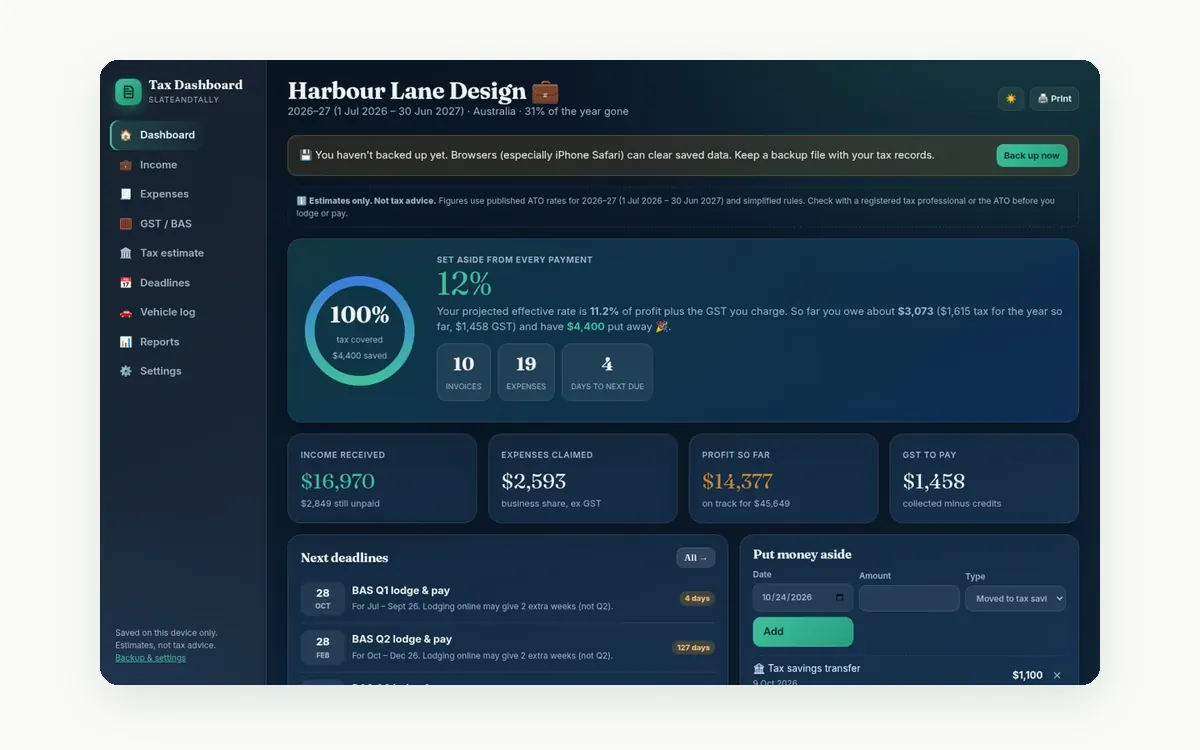
 Sole Trader Tax & BASTrack income, expenses and GST, see BAS figures by quarter, and estimate how much tax to set aside.See the app →
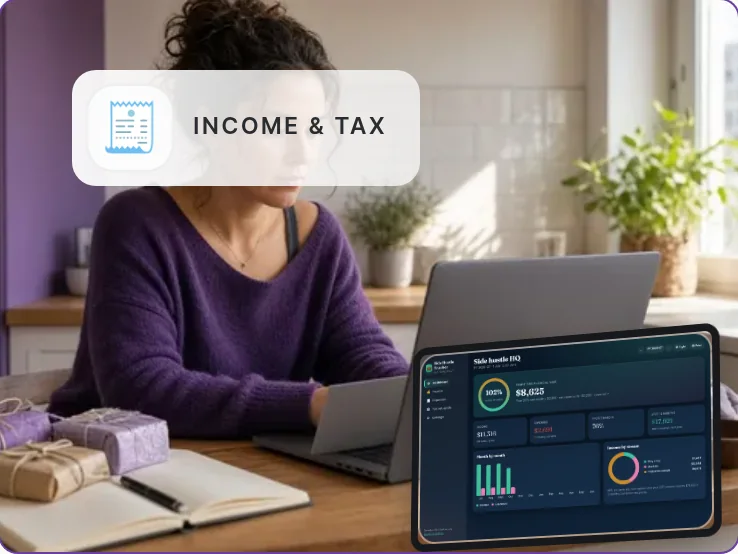 Side Hustle Tax TrackerTrack side-hustle income and expenses by Australian financial year, set money aside for tax, and watch the GST turnover threshold.See the app →
Setting money aside as you go
Most sole traders we hear from want one thing: no nasty surprise in November. A common habit is to move a slice of every payment into a separate savings account as it comes in. How big that slice should be depends on your own income and circumstances, so treat any percentage as a buffer you choose, not a calculation. Our free sole trader tax set-aside calculator gives you a rough estimate using the ATO rate table, and the sole trader tax time checklist lists what to gather before you lodge.
Keep records the whole year
Lodging is easiest when your income and expenses are logged as they happen. You will want each sale or invoice, each business expense with its receipt, and a running total of profit for the financial year. If you are registered for GST, you will also be tracking quarterly BAS figures. business.gov.au has a good overview of lodging and paying tax as a business.
Two apps that keep the numbers ready
We built two offline apps for exactly this. Pick the one that matches how big your business is.
Track income, expenses and GST, see BAS figures by quarter, and estimate how much tax to set aside, using 2025–26 and 2026–27 AU rates. It works offline in your browser, your data stays on your device, and there is no bank login. Secure checkout via Payhip.
See the Sole Trader Tax & BAS app · A$65
For an ABN side hustle next to a job: log income by stream and expenses by category, choose your own set-aside %, and keep an eye on the $75,000 GST registration threshold with a rolling 12-month turnover check. It works offline in your browser, your data stays on your device, and there is no bank login. Secure checkout via Payhip.
See the Side Hustle Tax Tracker app · A$29
Not sure which? Our sole trader tax tracker guide compares them.
Frequently asked questions
Do sole traders lodge a separate business tax return?
No. The ATO says sole traders report business income in their individual tax return, including the business and professional items section. Source: ATO.
Do I need to lodge if my ABN income was under $18,200?
The ATO says sole traders must lodge a tax return even if their income is below the tax-free threshold. Source: ATO.
When is my sole trader tax return due?
If you lodge yourself, the ATO says 31 October, or the next business day if that falls on a weekend or public holiday. Registered tax agents usually have later dates if you engage them before 31 October. Source: ATO.
Is my ABN income added to my wages?
It goes in the same return. The ATO says you declare your business income in your individual tax return, and the net income from your business is assessable income. Source: ATO.
Do your apps lodge my tax return?
No. Our apps help you log income and expenses and see estimates. You lodge through myTax or a registered tax agent. The apps are general information only, not tax advice.
General information only, not tax advice. We are not registered tax agents. Rules, rates and dates come from ato.gov.au and business.gov.au as checked on 27 October 2026 and can change. For your situation, check ato.gov.au or talk to a registered tax agent.